Long distance reflexives are in general more accepted in the insular North Germanic languages than in the mainland North Germanic languages (see e.g. Holmberg and Platzack 1995 and Thráinsson 2007 and references therein). However, binding into relative clauses seems to be more acceptable in the mainland varieties than in the insular varieties. As shown in (1), from Lødrup (2009), binding into a relative clause is sometimes possible in Norwegian:
(1)
Det
kan
og
se
ut
til
at
noen
av
informantenei
er
preget
av
særinteresser
som
gjelder
for
sinei
institutter.
(Bokmål.)
it
may
also
look
out
to
that
some
of
informant.pl.def.
are
influence.pass.part
by
special.interests
that
apply
for
rflx.poss.pl
department.pl
‘It may also seem as if some of the informantsi are influenced by the special interests that apply to theiri departments.’
As shown in (2), from Strahan (2011), binding into a relative clause is not possible in Icelandic:
(2)
*Það
getur
litið
út
fyrir
að
nokkrir
heimildarmannanai
séu
mótaðir
af
sérhagsmunum
sem
varða
sínari
deildir.
(Ice.)
*it
can
look
like
such
that
some
informant.pl
are
influence.pass.part
by
special.interestdef
rel
concern.pres
rflx.poss.pl
department.pl
*‘It may also seem as if some of the informantsi are influenced by the special interests that apply to theiri departments.’
Lødrup (2009) shows that binding into relative clauses in Norwegian is restricted to contexts where the subject of the relative clause is inanimate, or non-referential. This restriction does not apply to long distance binding into complement clauses in Icelandic, or so-called mid-distance binding into infinitival clauses in Mainland and Insular Scandinavian. Lødrup also shows that long distance reflexives can be complex in relative clauses, in contrast to the long distance reflexives found in Insular Scandinavian (see Lundquist 2014a and Lundquist 2014b for discussion on other types of non-local reflexives):
(3)
Huni
trodde
hun
gjorde
det
som
var
best
for
segi
selvi.
(Ice.)
she
think.past
she
did
it
rel
was
best
for
rflx
self
‘Shei thought shei did what was best for heri.
2. Results
2.1 Nordic Syntactic Database (NSD)
In the ScanDiaSyn survey, the following sentence was tested in Norway, Sweden and Finland:
(4)
folki
leser
vel
bare
de
brevene
som
er
til
segi
selvi.
(#116) (Nor.)
people
read.pres
presumably
only
the
letter.pl.def
rel
be.pres
to
rflx
self
‘Peoplei presumably only read the letters which are for themi’
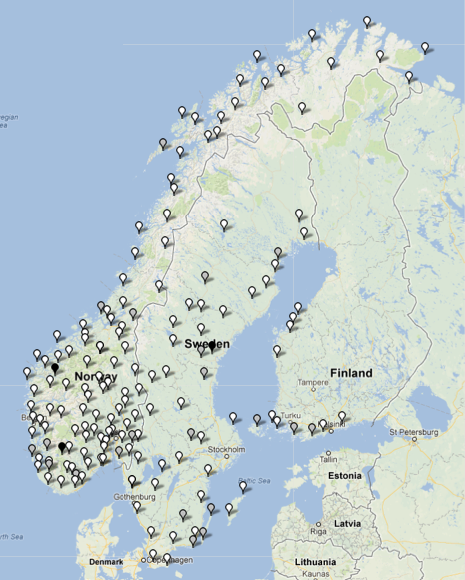
In this sentence, the subject of the relative clause is inanimate, and long distance binding across this subject is expected to be possible. As seen in the Map 1 below, this sentence is accepted in most of the measure points:
Map 1: Binding into relative clause.
(#116: Folk leser vel bare de brevene som er til seg selv. 'People presumably only read the letters which are for them.')
(White = high score, grey = medium score, black = low score)
There are some places where the sentence only gets a medium score, but there are no straightforward dialectal patterns. A closer look at the informants judgments shows that over 80 per cent of the informants gave the sentence a full score.
In Denmark, a set of four sentences was tested, where the co-referent element either has the form of a simple reflexive, a complex reflexive, a personal pronoun or a complex personal pronoun (‘herself’). The subject of the embedded clause is non-referential.
(5)
Huni
mente
hun
gjorde
det
som
var
bedst
for
sigi.
(#164) (Dan.)
she
claim.past
she
did
it
rel
was
best
for
rflx
‘Shei claimed shei did what was best for heri.
(6)
Huni
mente
hun
gjorde
det
som
var
bedst
for
sigi
selvi.
(#165) (Dan.)
she
claim.past
she
did
it
rel
was
best
for
rflx
self
‘Shei claimed shei did what was best for heri.
(7)
Huni
mente
hun
gjorde
det
som
var
bedst
for
hendei
selvi.
(#166) (Dan.)
she
claim.past
she
did
it
rel
was
best
for
rflx
self
‘Shei claimed shei did what was best for heri.
(8)
Huni
mente
hun
gjorde
det
som
var
bedst
for
hendei
selvi.
(#167) (Dan.)
she
claim.past
she
did
it
rel
was
best
for
rflx
self
‘Shei claimed shei did what was best for heri.
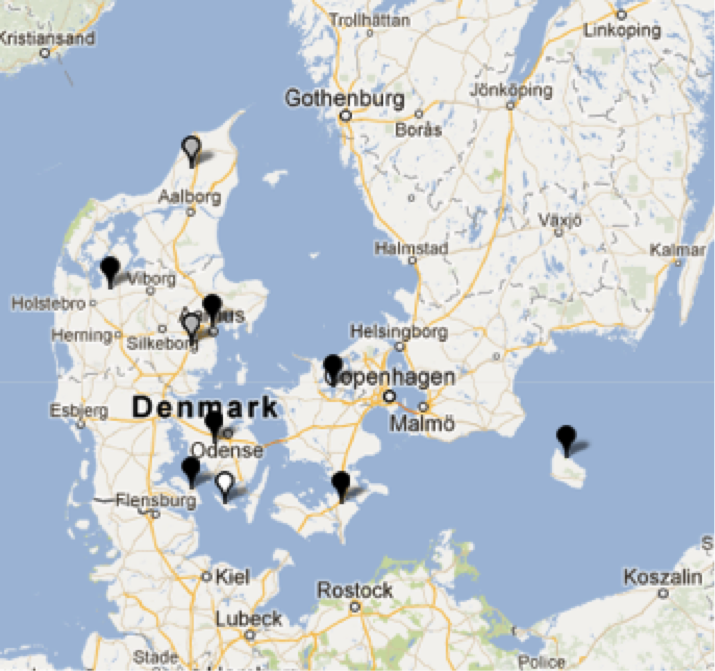
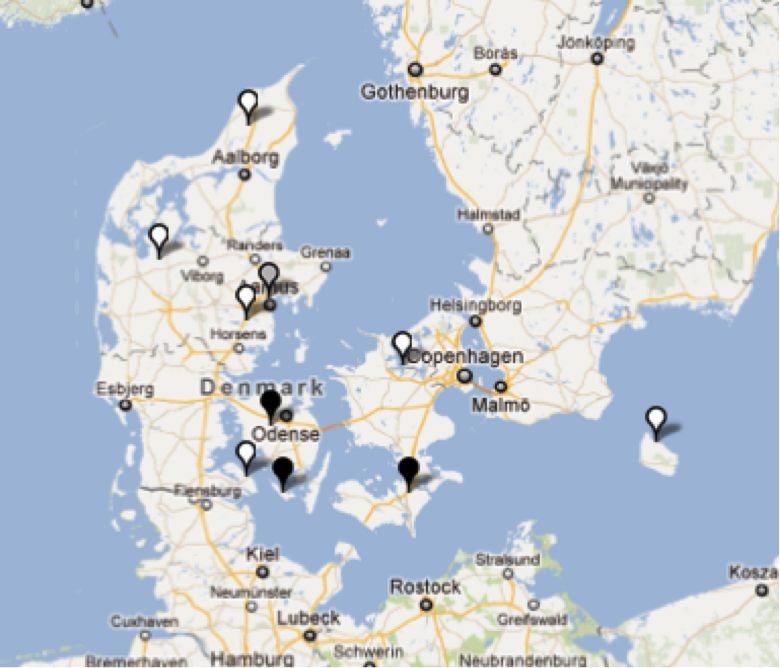
As the maps below shows, the complex reflexive form is the most acceptable form of the given alternatives (Map 3). The complex pronominal form is in general accepted as well (Map 5), while both simple forms are not accepted, with a few exceptions.
Map 2: Simple reflexive in relative clause.
(#164: Hun mente hun gjorde det som var bedst for sig. 'She claimed she did what was best for her.')
(White = high score, grey = medium score, black = low score)
Map 3: Complex reflexive in relative clause.
(#165: Hun mente hun gjorde det som var bedst for sig selv. 'She claimed she did what was best for her.')
(White = high score, grey = medium score, black = low score)
Map 4: Binding into an embedded object
(#166 Hun mente hun gjorde det som var bedst for hende selv. 'She claimed she did what was best for her.')
(White = high score, grey = medium score, black = low score)
Map 5: Complex co-referential pronoun in relative clause.
(#167 Hun mente hun gjorde det som var bedst for hende selv. 'She claimed she did what was best for her.')
(White = high score, grey = medium score, black = low score)
The maps show that there is dialectal variation here, especially when it comes to the complex pronominal form (map 5), which is not accepted on Fyn and southern Sjælland. It is also interesting that simple pronominal form (map 4) is only accepted on one measure point, namely Ærø. The acceptance for the simple pronoun is probably much higher in the rest of Scandinavia.
3. Discussion
Below I will first look at some data from other sources that cover Icelandic and Faroese. Thereafter I will discuss different factors that facilitate binding into relative clauses.
3.1. Other data sources
As was shown in the introduction, long distance binding of the type tested above (example 4, 5 and 6) is not accepted in Icelandic. In Faroese, however, binding into a relative clause is accepted to a higher degree. In the dialect survey carried out on the Faroese Islands (Thráinsson et al. 2008-2009, see discussion in Strahan 2011), it was found that 67 per cent of the informants found the following sentence acceptable:
(9)
Honi
visti
ongan,
sum
var
forelskaður
í
særi.
(Far.)
she
know.past
no-one
rel
was
enamorate.part
in
rflx.dat
’Shei knew no-one who was in love with heri.’
Note that a sentence with the same structure as (9) above is not acceptable in Icelandic: only 22 per cent of the Icelandic informants in the Icelandic dialect survey accepted the corresponding Icelandic version of (9) (Thráinsson et al. 2005-2007, see discussion in Strahan 2011). Note however that binding into relative clauses is possible in Icelandic as long as the clause hosting the relative clause is embedded under a verb of saying or believing, that triggers subjunctive marking on the embedded verbs, see Thráinsson (1990) and (2008), and Holmberg and Platzack (1995) for discussion on the so-called ‘Domino effect’. The following example is from Holmberg and Platzack (1995):
(10)
Jóni
segir
að
þetta
sé
stúlkan
sem
elski
sigi.
(Ice.)
Jon
say.pres.3rd
that
this
is.subj
gril
sem
love.subj
rflx.acc
’Johni says that this is the girl that loves himi.
We could suspect that the reflexive in the Danish test sentence (5)-(6) is also licensed by the superordinate verb of saying mene ‘claim’, just like in the Icelandic example above. However, the Icelandic long distance reflexive is always simplex. If Danish had a domino effect, we would expect (5) (simple reflexive) rather than (6) (complex reflexive) to be good.
3.2. Restrictions the intervener and the antecedent
As discussed in Lødrup (2009) and Strahan (2011), binding into relative clauses is licit in Mainland Scandinavian when the subject of the relative clause is inanimate or non-referential. Lødrup also shows that the intervening inanimate subject has to be a theme rather than a cause for LDR to be licit. The Swedish reference grammar (Teleman et al. 1999) also gives examples where the relative clause subject is an indefinite pronoun, like ingen ‘no-one’, similar to the Faroese example (9). When the subject of the relative clause is animate and specific, LDR is not licit in any of the North Germanic languages, as far as I am aware. Lødrup (2009) gives the following Norwegian ungrammatical sentence that presumably is bad all over Scandinavia:
(11)
*Deii
kjenner
mannen
som
kritiserar
segi
(sjølvi)
/bror
sini.
(Nor.)
*they
know.pres
man.def
rel
critisize.pres
rflx
self
love./brother
rflx.poss.sg
*int. ’Theyi know the man that criticizes themi/theiri. brother.’
We can tentatively conclude that LDR is licit in relative clauses only when an intervening subject is not likely to be a binder of an anaphor. For further discussion on this topic, I refer the interested reader to Thráinsson (2008), Lødrup (2009) and Strahan (2011).
The Norwegian/Swedish test sentence (4) and the Danish test sentences (5-8) differ with respect to the nature of the antecedent, i.e., the main clause subject. The antecedent in the Danish examples (5-8) is a specific third person pronoun, while the antecedent in the Norwegian/Swedish example (4) is a generically referring noun. As is discussed in Lundquist 2014c, generic, non-bound reflexives are accepted by many speakers in Mainland Scandinavia. There is slight chance that the informants that accept (4), treat the reflexive as a non-bound generic reflexive rather than a long distance reflexive. This possibility is brought up by Lødrup (2009), but according to him, at least some Norwegian speakers reject generic non-bound reflexives while accepting sentences like (4). In Swedish, many speakers (including myself) would find (4) equally marked (or unmarked) as (12) below, where the reflexive lacks a syntactic antecedent, and receives a generic interpretation (or possibly a first person/speaker interpretation):
(12)
?Det
är
alltid
spännande
med
brev
som
är
till
sigi
självi.
(Swe.)
?it
be.pres
always
exciting
with
letter.pl
rel
are
to
rflc
self
? ‘It is always exciting with letters that are for one self.’
However, there are Swedish speakers who allow binding into relative clauses even when the reflexive has a non-generic reference. The Swedish reference grammar (Teleman et al. 1999, 2:343) gives the following example, where the antecedent is specific (and the intervening relative clause subject is indefinite), which is said to be acceptable for at least some speakers:
(13)
Hani
har
ingen
som
ser
till
sig
nuförtiden.
(Swe.)
he
have.pres
no-one
rel
look.pres
after
rflx
nowadays
‘Hei has no-one that looks after himi these days.’
According to the Teleman et al. (1999), the main clause verb influences the possibility of relative clause LDRs. According to them, binding into a relative clause is only possible when the main clause verb denotes some kind of possession, i.e., when the subject is a possessor of the object that contains the relative clause with the anaphor. If this claim is correct, there are as many as four different factors that influence the acceptability of long distance reflexives in relative clauses:
XXX1. The nature of the main clause subject/antecedent: Generic vs. specific..
XXX2. The nature of the intervening relative clause subject: definite/specific vs. indefinite/non-referring.
XXX3. The main clause predicate: verb of possession vs. other types of verbs.
XXX4. The embedded predicate: agentive/causative verbs vs. stative verbs (i.e., long distance binding is not possible when the intervening subject is an agent/causer).
More research needs to be done to establish whether all these factors are relevant in all of the North Germanic languages.
References
Faarlund, Jan Terje, Svein Lie and Kjell Ivar Vannebo. 1997. Norsk referansegrammatikk. Universtitetsforlaget, Oslo
Holmberg, Anders and Christer Platzack. 1995. The Role of Inflection in Scandinavian Syntax, Oxford University Press, Oxford.