Nordic Atlas of Language Structures (NALS) Journal, Vol. 2
Copyright © E. M. Petzell 2017
Licensed under a Creative Commons Attribution 3.0 License
Enclitic
subjects and agreement inflection in Viskadalian
Swedish
Erik M. Petzell
Institute for Language and Folklore,
Gothenburg
Abstract:
In this article, I describe the subject clitics
of the traditional Swedish dialect in Viskadalen; I
refer to this variety as “Viskadalian”. The Viskadalian subject clitcs are prosodically dependent on a verbal host to their left;
thus, they occur only with VS word order. In most cases, it is the clitic that conveys the reference of the subject (kan=ik, ‘can.prs.sg=I’, kan=et, ‘can.prs.sg=it’).
However, when the verb is inflected for both number and person, Viskadalian uses the seemingly meaningless clitic ä: fing-em=ä, ‘get.pst.pl-1pl=ä’, så-st=ä, ‘see.pst-2sg=ä’. I
argue that the clitic ä is not a pure expletive but in fact represents a partially
reduced phi-feature bundle: it is a pronominal version, as it were, of such partially
reduced verbal agreement endings in VS contexts that have been attested in many
Germanic varieties.
Key words:
Enclitic subject pronouns, Swedish dialects, Viskadalian,
Verbal agreement, VS word order, Phi-feature reduction
1. Introduction
This article deals with finite verbs and their pronominal subjects in
the Swedish dialect of Viskadalen, ‘the valley of the
river Viskan’. The river Viskan,
which is the northernmost of the rivers of Halland
(the others are Ätran, Nissan and Lagan), actually
starts in the province of Westrogothia (Sw. Västergötland) before it meets the sea of Kattegat just
north of the town of Varberg; see Map 1. I will refer
to the traditional dialect of the area around the southern reaches of the river
Viskan as Viskadalian.
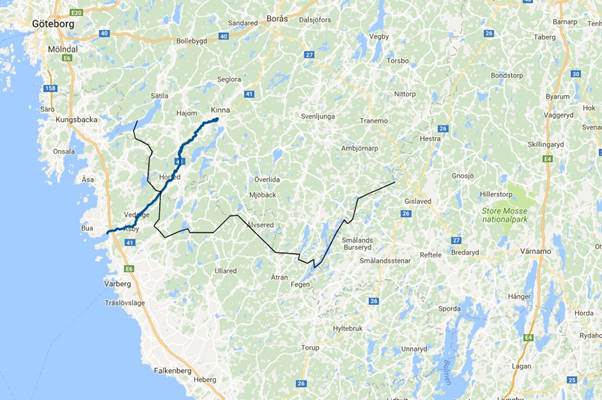
Map 1: Viskadalen (southern reaches of the river Viskan in blue, southwestern
border between Westrogothia and Halland
in black).
1.1. Presentation and aim
Viskadalian has preserved
much of the old agreement inflection on finite verbs,
both for number and person, an archaic trait which is found to a varying extent
in traditional dialects all over the southwest of Sweden (see Horn af Åminne 2015). However, what is
limited to the area around Viskan is an entire
paradigm of subject pronouns that cliticize to the
right of the finite verb. For instance, in the first person singular, the
subject corresponds to the enclitic ik when there is subject-verb inversion (i.e. VS word
order), but to the free pronoun ja in SV-contexts; see
(1a–b). [1]
(1) a. sen börja-r=ik
(Grimm:227)
then begin-prs.sg=I
‘Later,
I’ll begin.’
b. dä ja gjor-de (Värö1:245B)
that I do.pst-pst
‘that,
which I did’
Intriguingly, when verbal inflection is distinctive
(i.e. is only used for that grammatical person), the enclitic pronoun has the
same form, irrespective of what person the subject is. Thus, both when the verb
is inflected for first person plural (as in (2) below) and when it is inflected
for second person singular (as in (3)), the post-verbal subject is enclitic ä; see (2a, 3a). With subject initial
order, on the other hand, the subjects are different in the two cases, vi and du respectively, as I show in (2b, 3b).
(2) a. Då fing-em=ä lära gusohl
(Öxn1:6804A2)
then get.pst.pl-1pl=ä learn.inf god’s-word
‘Then, we were taught the word
of God’
b. Vi la-om=em om kôrs
(Strå:224B)
we put.pst-1pl=them about cross
’We crossed them’
(3) a. Vai-st=ä vau, jau tôck-er (Värö3:3)
know.prs-2sg=ä what, I think-prs.sg
‘You know what, I think’
b. Du ä-st då an rektier sketmari. (Ist1:6213)
you.sg be.prs-2sg then a proper bore
‘You’re such a bore’
This article aims at describing and mapping the Viskadalian
system of subject clitics. In other words, I am
interested both in the system in itself and in where, geographically, the
different clitics can be found. In addition, I will
relate my findings to previous research about VS order and reduced forms in
general.
The Viskadalian system as a
whole is a reconstructed system, insofar as there is no single informant
displaying all of its features. The lack of such an informant has a trivial explanation:
all informants are now dead (the youngest of them were born around 1900). Thus,
Viskadalian is like any historic variety; in order to
describe it, we are dependent on an array of different sources, each of which
contributes pieces to the larger puzzle. At the same time, Viskadalian
is indeed alive (in some sense of the word), since we can still listen to it in
audio recordings from the middle of the 20th century.
1.2. Background
As far as I know, no dialectologist has (hitherto)
taken an interest in Viskadalen. This lapse is hardly
surprising, given the strong focus on the province (Sw. landskap)
as the natural area of inquiry within traditional dialectology. Being situated
on the border between Halland and Westrogothia,
Viskadalen, as a whole, simply falls out of the scope
of such studies. As a rule, the dialect of each province has been given a
separate description. From such a perspective, both the Hallandian
and the Westrogothian part of Viskadalen
emerge as peripheral areas within their respective provinces.[2]
When, on occasion, some linguistic parallel between southwestern
Westrogothia and northern Halland
comes up, it is merely noted as a parenthetical piece of information. For
instance, Lundell (1909:1110) points to the unity
between northern Halland and the hundred
of Mark (roughly, the part of Westrogothia closest to
the river Viskan on Map 1) regarding 1pl and 2sg morphology (cf. examples (2) and (3) above); his remark is
made in passing and the link is never explored any further.
The border between Westrogothia
and Halland, cutting through Viskadalen,
is, in fact, more than just a provincial border; before 1645, it was the border
between Denmark and Sweden. However, as stressed by Grill (1954), this was a
political border, which did not coincide with the economic border. For Westrogothians living along the river Viskan,
the place to sell their agricultural produce was always the Danish town of Varberg; its hinterland reached the parish of Örby, located where the highlighted part of the river Viskan ends on Map 1 (Grill
1954:679; see also Linge 1969:75–76). In other words,
Viskadalen has been an economic region for centuries.
As such, it forms a natural dialect area.
1.3. Viskadalian data
Most of the Viskadalian data
that I use in this article were collected around the middle of the 20th
century by local dialect archives in Lund (linguistic data from Halland) and Uppsala (data from Westrogothia).
All these data have now been incorporated in the collections of the national
Institute for Language and Folklore. The earliest written archive records are
from the end of the 19th century, the first audio recordings from
the mid-1930s.[3] My empirical
focus is on recorded speech. More specifically, for the mapping of the Viskadalian dialect (in section 2.1 and 2.3.1), I consider
only spoken data.
There are at least two reasons for basing the maps on
recorded speech only. First, the (more or less) spontaneous language use in the
audio recordings is indeed primary linguistic data and, as such, is comparable
across the area; it is homogeneous enough to translate well into dots on a
linguistic map. The contents of the written records, on the other hand, are
filtered by the collector in the field. To be more precise, the written records
contain what the collector wanted to document; in some cases, the purpose is
clearly ethnological rather than linguistic. Thus, they are not only secondary
data but are also quite diverse both qualitatively and quantitatively when
compared across a larger area.[4] In addition to
the archive data, there are other written sources of interest to this study.
For instance, there are linguistic descriptions of Viskadalian
from before 1800, and there are numerous collections of dialect data that have
been compiled by local amateurs who are interested in the traditional language
of their home parish. It would only be misleading to try to convert all these
various sorts of secondary data to (seemingly) comparable dots on a map.
Nevertheless, the written records often have the virtue
of containing forms and types of examples that are hard to come by in the audio
recordings. Generally speaking, reference to second
person is very scarce in the spoken material, which is simply a consequence of
the documentation situation and the questions asked. Typically, the
interviewer asked questions about local life in the past: “What was it like
when you grew up?”, “What did people do?”, etc.
Naturally, this triggers narratives in first and third person. So for second person examples, I have turned to such written
material that aims at documenting other phenomena than pure narratives. For
instance, many of the second person examples are from collections of children’s
games and funny stories.
How much of the traditional dialect still
lives on is, at present, largely unknown. During the
spring of 2016, I conducted a couple of interviews with people from the parish
of Istorp in the heart of Viskadalen,
just east of Horred on Map 1. These informants still
used some of the traditional morphology under investigation in this article, at
least in certain contexts. In the following, I will relate these recent data to
the traditional data.[5]
However, I should make it clear that my main object of study in this article is
the traditional dialect. A more comprehensive description of modern Viskadalian would, of course, be of great value. Hopefully,
it will be possible for me to take on that task in the not too distant future.
2. Results
In this section, I first present the Viskadalian
agreement inflection on finite verbs (2.1). This is followed by a description
of the form and syntactic distribution of the Viskadalian
subject pronouns (2.2). Finally, I address the spread of the enclitic pronouns
across the dialect area (2.3).
2.1. Person and number agreement on finite verbs
The Viskadalian verbal agreement affixes are
given in (4) below. This paradigm is more or less identical to what we can
reconstruct from Old Swedish sources (see Wessén
1958:116–118). An important difference, however, regards the 2sg affix: it combines with a much
larger group of verbs in Viskadalian than it did in
Old Swedish. In mediaeval texts (both from Sweden and Denmark), the (s)t-ending for
2sg was (as it still is in
Icelandic) quite restricted: it occurred only with strong preterites
(including preterite-present verbs in the present
tense):[6] kan-t, bröt-st, ‘can.prs.sg-2sg, break.pst-2sg’ (Belfrage 1871:13, Wessén
1958:133, Skautrup 1944:276). In Viskadalian,
this 2sg affix is more versatile.
In fact, in this variety, all verbs except those ending in present tense r occur with (s)t. The most apparent effect thereof is
that Viskadalian contains an abundance of weak preterites inflected for 2sg,
forms never found in the mediaeval language: ha-dde-st, bo-dde-st, vess-te-st,
‘have-pst-2sg, live-pst-2sg, know.pst-pst-2sg’.[7]
Turning now to the plural, all persons retain the
vowel e from the past tense affix of
regular verbs (which is te/de), the 3pl form then coinciding with 1/3sg: tal-te-m, tal-te-n, ‘speak-pst-1pl,
speak-pst-2pl’, tal-te,
‘speak-pst’. The vowel is also
the same with monosyllabic verbs in the present tense, the vowel coinciding
with the stem vowel, and the 3pl
form coinciding with the infinitive: ha-m,
ha-n, ‘have-1pl, have-2pl’,
ha, ‘have.pl/have.inf’; få-m, få-n,‘get.prs-1pl,
get.prs-2pl’ få
‘get.prs.pl/get.inf’).
Disyllabic verbs in the present tense, on the other hand, trigger different
vowels in all cases: e for 2pl (kunn-en, ‘can-2pl’), a for 3pl, this form again coinciding with the infinitive (kunn-a, ‘can-prs.3pl/can-inf’), and u (or o) for 1pl (kunn-um, ‘can-1pl’).
Furthermore, strong verbs in the past tense come with an e in 2pl and 3pl (åt-en, åt-e, ‘eat.pst-2pl, eat.pst-pl’), and with o/u in 1pl
(åt-om, ‘eat.pst-1pl’).[8] The
parentheses around 2pl n indicate that it is sometimes absent,
sometimes present. Naturally, when n
is absent, the forms for 2pl and
3pl usually coincide, both ending
in e (e.g. I/da åt-e, ‘You.pl/they
eat.pst-pl’). Without the n,
it is only with disyllabic verbs in the present tense that there is a
difference in the paradigm between 2pl
and 3pl (kunne – kunna), the latter form, however
(as noted), coinciding with the infinitive.
(4)[9] 1/3sg
– -
2sg – (s)t
1pl – u/o/e-m
2pl – e(-n)
3pl – e/a
In the dialects surrounding Stockholm, the person distinction in the
plural seems to have been lost before 1500 (Neuman
1925), and number during the 17th century (Larsson 1988). In what is
present-day Denmark, verbal agreement was probably lost even earlier (Skautrup 1944:273–274).[10] However, the
dialects in the southern provinces of Sweden, which once (before the middle of
the 17th century) belonged to Denmark (these provinces include Halland, Skåne and Blekinge), people continued to inflect their verbs for
person and number long into the 20th century. As pointed out in the
introduction, Viskadalen is part of this larger
southwestern (from a Swedish perspective) dialect area, featuring agreement
morphology on finite verbs. How much of the paradigm in (4) is preserved across
this area varies considerably; see Horn af
Åminne (2015) for details.
As stated above, the audio recordings contain
instances of reference to second person only sporadically. Those inflectional endings in (4) that appear in
recorded speech are thus predominantly 1pl
and 3pl. I have listened to
recordings from 76 parishes in Halland, southwestern Westrogothia and
western Småland, paying special attention to verbal
inflection and pronominal subjects; see the appendix for more details about
these recordings.
On Map 2 below, all 76
parishes are represented by coloured dots (located where the parish churches are).
The colour of the dot indicates the extent to which I have come across person
and/or number inflection of finite verbs in spontaneous usage. White means that
the recorded informants do not inflect their verbs for person/number. Light
grey indicates that verbs are inflected for number, with e as a generalized plural ending. Black means that there is
inflection both for number and person, and that the 1pl forms end in m.
In some parishes further to the south in Halland,
both the 1pl and the 2pl end in n; this is marked with dark grey.
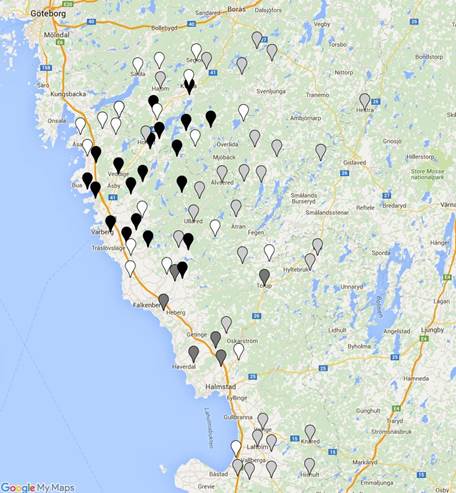
Map 2:
Agreement inflection on finite verbs in spontaneous speech (white = no
inflection; grey = only number; black = m for 1pl; dark grey = n for 1pl).
There are 20 black dots on Map 2. This means that I
have come across spontaneous usage of the m-ending
for 1pl along with verbs agreeing
with 3pl subjects in 20 of the 76
parishes that I am considering. There are sporadic occurrences of inflection
for second person as well, but these have no bearing on the mapping of inflection
(for reasons given in 1.3 above). Some of the informants represented by the
black dots inflect their verbs in all possible contexts; others switch, on
occasion, to a more standard-like system (with no agreement morphology
whatsoever). The informants of the former type are all from the parishes
immediately surrounding the southern reaches of the river Viskan.
2.2. Pronominal subjects in Viskadalian
The complete Viskadalian paradigm of pre- and
post-verbal subject pronouns is given in (5) below. Here, I use a disyllabic
modal verb like kunn-a, ‘can-inf’, in the present tense, since all the inflectional
distinctions in (4) are then put to use. Note that the pre-verbal pronouns do not
have to come before the verb: they are free pronouns that can occur both before
and after the verb (just like any subject). In contrast, the post-verbal
pronouns always need to cliticize to the right of the
finite verb. Note also that 2sg
and 2pl differ with respect to
the usage of the enclitic ä: the ä occurs in 2sg even without person agreement morphology on the verb (see
(5bʹ) with komm-er, ‘come-prs.sg’); in 2pl, on the other hand, the presence of n in the affix is a prerequisite for ä (cf. 5g to 5gʹ).
(5) a. 1sg:
ja kan/*ik kan – kan=ik/kan ja
b. 2sg:
du kant/*ä=kant – kant=ä/kant du
bʹ. 2sg: du kommer/*ä=kommer -
kommer=ä/kommer du
c. 3sg.m: han kan/*en=kan[11] –
kan=en/kan han
d. 3sg.f: hu kan /*(n)a=kan – kan=(n)a/kan hu[12]
e. 3sg.n de kan /*et=kan – kan=et/kan de
f. 1pl:
vi kunnum/*ä=kunnum – kunnum=ä/kunnum vi
g. 2pl:
I kunnen/*ä=kunnen – kunnen=ä/kunnen I
gʹ. 2pl: I kunne/*ä=kunne – *kunne=ä/kunne
I
h. 3pl:
da kunna/*di=kunna – kunna=di/kunna da
In addition to this schematic presentation of the Viskadalian
pronominal system, I provide authentic examples for each person and each word
order (SV and VS) in (6).
(6) a. när ja e faret te – de höga-r=ik inte
when I be.prs gone to that remember-prs.sg=I not
‘when I went to’ (Öxn1:6805B)
– ‘I don’t remember that’ (Värö1:245A)
b. när
du bo-dde-st i – kom här ska-t=ä
when you.sg live-pst-2sg in come.imp here shall.prs.sg-2sg=ä
få sai
get.inf see.inf
‘when you lived in’ (Mark:3) – ‘come here and
you’ll see’ (Gsjö:1037)
bʹ. å du se-r, da – stryk-er=ä katta
and you.sg see-prs.sg they pet-prs.sg=ä cat.def
‘you see, they ’ (Käll:350B) – ‘if you pet the cat’ (Mark:96)
c. han va stränger
– de fick=en
he be.pst.sg strict that get.pst.sg=he
‘he was strict’ (Surt:7589B2) – ‘he was granted that’
(Öxn1:6805B)
d. hu ska la
– så ge-dde=na sina barn
she shall.prs.sg mod.part so give-pst=she refl.poss children
‘she’ll probably’ (Öxa:5187) ‘then,
she gave her children’ (Ist1:6212)
e. de va mö värre – så bloi=et släckt
it be.pst.sg much worse so become.pst=it extinguished.ptc
‘it was much worse’ (Örb1:6209) – ‘finally, it was put
out’(Grime:1937B)
f. vi vör-um la fem – så sto-um=ä mittemot
we be.pst.pl-1pl mod.part five so stand.pst-1pl=ä opposite
‘we were probably five’ (Ist1:6214) – ‘then, we stood opposite’
(Grimm:227)
g. um I ork-en
– när geng-en=ä te
if you.pl manage-2pl when go.pst.pl-2pl=ä to’
‘if you can manage’(Värö3:1) – ‘when did you go
to’(Strå:224B)
gʹ. I behöv-e la inte
– minn-e-s I
you.pl need-pl mod.part not remember-pl-dep you.pl
rövara
robbers.def
‘you don’t need’ (KarlG:1676:1) – ‘can you
remember the r.’ (Öxn1:6805A)
h. när da komm-a – de gör-a=di
when they come-prs.3pl that do-prs.3pl=they
‘when they come’ (Gsjö:1037) – ‘they do that’ (Vedd:2064A)
2.2.1. The form of the pronouns
Let us now consider the particular pronominal forms. The free pronouns
are in most cases identical with the corresponding standard forms: ja,
du, han, de, vi. Hu is more of a Viskadalian
trademark. Further to the east, the vowel is different (ho in eastern Westrogothia,
Landtmanson 1950:93), and further to the south, there
is usually a final n (Colliander 1868:23), as in the standard language (where the
pronoun is hon). The 3pl da
is a monophthongized version of dai, which
is still found further down in Halland. 2pl I
is common all over southern Scandinavia (including
standard Danish). In standard Swedish, the 2pl
pronoun is ni.
As for the clitics, one
might inquire whether the clitics are simple or
special. The former is a reduced form of the full version, the latter a form
that is not synchronically derivable (phonologically) from the full form; this
distinction was first suggested by Zwicky (1985; see also Howe 1996:28–31). The
division between simple and special clitics may well
have theoretical implications, but here I use it merely as a useful descriptive
tool. There are, it seems, clear examples of special clitics,
but only potential examples of simple clitics in Viskadalian.
A clear case of a special clitic
is 1sg ik. Historically, the form ik predates ja;
the latter is derived from the former by so-called breaking, which is
presumably some sort of assimilation process (see Dyvik
1978). Synchronically, however, the forms are not phonologically related. The
same goes for hu
and na.
Originally, na is from the oblique paradigm, corresponding to Old
Swedish hana,
‘her.acc’
(Wessén 1958:188, Howe 1996:295; cf. also footnote 12
above).
The di could
possibly be a special clitic as well, given that
there is no synchronic phonological rule in Viskadalian
that converts a (in da) into i. Still, the original
diphthongized pronoun dai, commonly occurring further down in Halland (as already mentioned), was once more widespread in
Westrogothia too (Landtmanson
1950:96); dai
is clearly in a simpler relationship with the di-form than da
is. Also, the status of di as
a clitic is quite recent: in a not too distant past,
the di was an allomorph of the free
pronoun (see also 2.3.1 below).
Moving on to et, it could belong to either category. One possibility is
that it is a synchronically distinct form that is etymologically related to
Gothic 3sg.n ita (as
suggested by Noreen 1904:§508), in which case we should treat it as a special clitic. Alternatively, it is simply a reduced form of det (as proposed
by Reinhammar 1975:177), which makes it a simple clitic (given that the free pronoun de is also a reduced version of det).
As for en, it was most likely derived in the same fashion as na,
namely from the oblique paradigm. As an enclitic object, en was commonly used in all sorts
of Swedish texts up until the 18th century; however, as a subject,
it is only sporadically attested (see Wessén 1958:188–189
for examples). Whether en is synchronically related to han is hard to
say; unlike the feminine, the masculine clitic shares
with the free pronoun the vowel+n structure (cf. fem. hu vs. (n)a). However, deletion of initial h is hardly a general process in the
dialect, although it tends to occur elsewhere in the pronominal system (see Landtmanson 1952:46).
Turning now to ä,
it is clearly a special clitic, at least in 2sg and 1pl. Both du and vi are impossible
to convert to ä in the synchronic phonological
system. Historically, however, precisely this development appears to be
derivable in both contexts. In 2sg,
the initial dental of the pronoun is vulnerable to reduction, since the affix
ends in a dental too: (s)t + du.
In our earliest record of Viskadalian (Öxn3), which
is a wedding poem from 1746 (appearing in Lundell
& Hesselman 1937), the dental of the pronoun is
intact, whereas the vowel is more or less identical with the vowel of the clitic (spelled e
rather than ä). More specifically, we
can detect the post-verbal dental in VS sequences containing a verb form that
ends in present tense r. Since we
expect no (s)t affix in such cases (see the beginning of 2.1
above), the dental sound must stem from the pronoun. Thus, the spelling with hl, indicating a retroflex r [ɽ] in hahle höht, ‘have you heard’ (Öxn3:311) only makes sense if
the r-ending of the verb (har) is followed
by dä. (Merging [r] and [d] into [ɽ] is still a common process in many Scandinavian
varieties.) If the subject
were ä, we would, instead, expect hare.
As we saw above, precisely such forms occur in the more recent Viskadalian sources (see (6bʹ)). Consequently, here, the subject is clearly ä rather than dä (as before).
In 1pl
contexts, on the other hand, it is often impossible to determine whether the
enclitic pronoun is ä or mä. We know that
the 1pl pronoun has indeed become
mä (or some
similar form) in many Norwegian dialects (see Tylden
1944), as well as in some Swedish dialects close to the Norwegian border; for
instance, in the traditional dialect of the province of Härjedalen,
the 1pl pronoun is mö (Pamp 1978:118). In Viskadalian, I
have found no clear cases of an m-initial
1pl pronoun. On the contrary,
there are examples in the written records that indicate that the pronoun is
indeed ä: dä hôpp-um-s=ä, ‘that hope-1pl-dep=ä’ (Öxn2:01). In this example,
the affix and the clitic are separated by the
deponent marker s; if the clitic were mä, we would expect *hôppums=mä. Presumably, the
change in vowel quality (i ä) occurred
later than the reduction of v. We
thus find examples such as ha-de-m-i, ‘have-pst-1pl=we’ (Öxa:5187),
indicating a dropped v but no other
difference from the free pronoun (i.e. the i of vi is intact).[13] The parish of Öxabäck, where this example is recorded, is located on the
edge of the Viskadalen area, where the last step
(i.e. ä) is not attested.
Moving on to 2pl,
I have not found any examples that unambiguously indicate that the clitic is indeed ä,
rather than nä.[14] Certainly, I
have shown that the m-ending was
never reanalyzed as part of the 1pl pronoun in Viskadalian
(as in other Scandinavian varieties further to the northwest). However, the
mere lack of m-pronouns in 1pl does not automatically exclude the
possibility that there might be n-pronouns
in 2pl. Consequently, the ä in 2pl
is analogically stipulated: since the ä
follows the distinctive m in 1pl, I assume that it follows the
distinctive n in 2pl too.
2.2.2. The clitic
status of post-verbal pronominal subjects
Although there are certainly differences between
definitions of clitics in the literature (see Spencer
& Luis 2012:12 for an overview), the following criteria, at least, are
generally included: clitics play a role in syntax (as
independent words but unlike affixes) but they are prosodically
dependent on some other word. In both these respects, the Viskadalian
post-verbal pronouns are clitics: they need a host,
namely a finite verb; at the same time, they are syntactic subjects, filling
the inverted subject position in the syntactic structure. This means that the clitic is syntactically real insofar as it cannot combine
with another subject, as I show in (7a) below. Furthermore, since the clitic needs to keep close to its verbal host, other
elements that can also follow the verb must never precede the clitic. Thus the clitic pronouns
are never found post-adverbially, nor in a position after shifted objects; see
(7b–c). In these contexts, the free pronoun is the only option.
(7) a. *Vi ha-de-m=ä
we have-pst-1pl=ä
b. ?*minn-s inte ik (Ist2) (cf. dä minn-s inte ja)
remember-dep not I that remember-dep not I
‘I don’t
remember that’(Öxn1:6806A1)
c. ?*tog seg na (cf. sen tog seg hu ett glas ock (Ist2))
take.pst refl she then take.pst refl she a glass too
‘then, she too had a drink’
The subject positions in (7b–c) are typically associated with some sort
of prosodic prominence (often conveying contrastive focus). Certainly, post-verbal
subjects that are indeed adjacent to the verb (unlike the subjects in (7b–c)
may also be prosodically prominent; if so, they are
realized as free pronouns, as shown (8a) below. Here, there is a clear contrast
between the two possible agents ‘you’ and ‘I’; hence, the post-verbal subjects
are du and ja (rather
than ä and ik). Furthermore, since the clitics are so tightly bound to the finite verb, they can
never be part of a larger DP; only the free pronouns are possible in such
contexts; see (8b).
(8) a. Ska-t du by-a på snus eller ska
shall.prs.sg-2sg you.sg offer.inf on snuff or shall.prs.sg
ja snus-a i din dosa?
I snuff.inf in your.sg box
‘Are you going
to offer some snuff or shall I snort from your box? (Fag:110)
b. Dä fing-em [vi barn] göra – *dä fing-em=ä
that get.pst.pl-1pl we kids do.inf that get.pst.pl-1pl=ä
barn göra
kids do.inf
‘We kids had to
do that.’(Ist1:6213)
Under standard assumptions, the finite verb preceding the clitic is in Co (the V2 position). When Co hosts a complementizer
rather than a finite verb, the subject is never a clitic:
(9) ?*Ja sa att=ik skulle gå
(Ist2)
I say.pst that=I shall.pst go.inf
The lack of examples such as (9) indicates that we are dealing with
verbal enclisis, not cliticization
to Co (as in some West Germanic varieties, as we will see in section
3). The association between Co and the clitic
is indirect, on account of Co being the only position where the verb
precedes the subject.
In sum, VS order is a necessary (but not sufficient)
condition for the Viskadalian subject clitics. In addition, the VS sequence needs to be inside
the same prosodic phrase. In other words, there can be no intervening material
between V and S (as in (7b–c)), nor can S itself be prosodically
prominent (as in (8a)) or part of another phrase (as in (8b)). I will return to
the significance of prosody for a deeper understanding of the Viskadalian clitics (especially
the versatile ä) in section 3.
2.3. Mapping the enclitic pronouns
In what follows, I take the reader through the paradigm in (5–6) person
by person. As stated above, only first and third person morphology occur in audio
recordings to such an extent that making maps of their spread is meaningful. I
therefore start with first and third person clitics
in 2.3.1, where I present dialect maps based on the actual attestation of these
features in spontaneous speech across the area. In 2.3.2, I discuss the written
documentation of second person morphology in Viskadalian,
trying to reconstruct the reality behind the records.
2.3.1. First and third person –
occurrence in actual usage
Starting with 3sg, these
three pairs of free pronouns and clitics (see (5c–e)
and (6c–e) above) are not only spread across Viskadalen
but are also found in neighbouring areas (see Landtmanson
1950:92–93, 96 for examples from Westrogothia). In
other words, although clearly part of the clitic
system under scrutiny, they are hardly distinctively Viskadalian
traits. In addition, as enclitic objects, the forms en, na, and et are even more widely spread (SAG
2:271).
With 1sg
ik, quite
the contrary is true: it is only attested in recordings from 6 parishes in the
central part of Viskadalen; see Map 3. This
geographical limitation is confirmed by Kalén in his
work on Fagered, a parish in Halland
just on the border of Westrogothia (between Ullared and Älvsered on Map 1). Kalén notes that ik does occur in Fagered, but that
all those using it have moved there from neighbouring parishes in Westrogothia (1923:137). Although geographically
restricted, ik
appears to be quite stable where it is attested. In the Viskadalian
wedding poem from 1746 mentioned above (Öxn3), the enclitic 1sg pronoun is there: så bli-r-ek, ‘so become.prs.sg=I’ (Öxn3). Also, among present-day
people in the area who still preserve features from the traditional dialect, ik is one of the
traits that live on (dä kan=ik inte,
‘that can.prs.sg=I not’ (Ist2)).
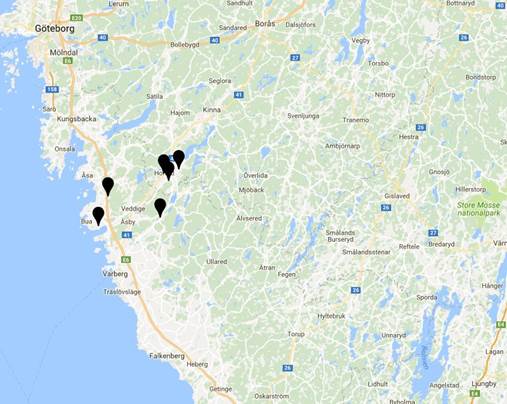
Map 3:
Enclitic ik in spontaneous
speech (see (6a)).
A more widespread trait is the usage of the clitic ä in 1pl: ha-de-m=ä,
‘have-pst-1pl=ä’ (Gsjö:1036B).
This is found in recordings from 11 parishes in the Viskadalian
heartland; see Map 4. The m-inflection
alone is spread over a slightly larger area than 1pl ä,
both further to the north-east and to the south (cf. Map 2). In these areas,
post-verbal 1pl reference is
realized in a variety of ways. We encounter post-verbal vi (i.e. the free pronoun) on a more regular basis (tok-om vi då,
‘take.pst-1pl we then’ (Tores:255A_m24)). In
some recordings, the 1pl affix is
missing in precisely these contexts (dä ha vi, ‘that
have.pl we’ (Örb2:6207)),
although it is present with SV order (vi
ha-m aldri, ‘we have-1pl never’ (Örb2:ibid.)). A third
possibility is that the post-verbal subject is fully deleted (så ha-d-om fyra,
‘so have-pst-1pl four’, Dags:2911B).
By contrast, in the ä-varieties, the
affix is hardly ever missing, and the pronoun itself may be omitted only if it
is directly followed by a vowel, indicating that in those cases we are dealing
with a purely phonetic reduction: kall-te-m(=ä)=et, ‘call-pst-1pl(=ä)=it’, (Strå:224A). Today,
general deletion of inverted 1pl
subjects appears to have spread towards the northeast: from Istorp
(Ist2), I have collected examples such as då riv-om la, ‘then destroy.prs-1pl
mod.part’, and dä höpp-um-s
la, ‘that hope-1pl-dep mod.part’, where there is clearly no
subject, although the following word does not begin with a vowel (cf. the
similar example from Dags above).
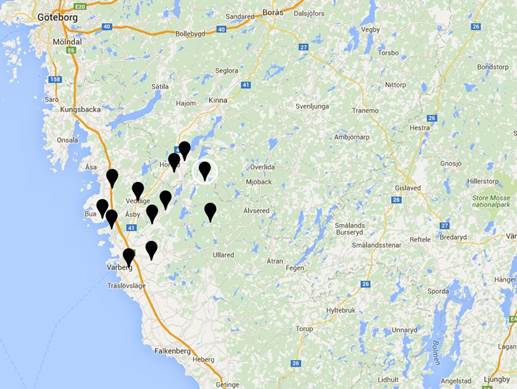
Map 4:
Enclitic ä after 1pl m in spontaneous speech (see (6f)).
Moving on to 3pl,
the distinction between a free pronoun da
and an enclitic di (see (6h–h')) is not
mentioned in the previous literature. Both Landtmanson
(1950) and Kalén (1923) note that there are certainly
several forms of the 3pl pronoun,
but neither identifies di as a clitic. However, in 11 of the audio recordings that I have
listened to, the distinction between free da
and enclitic di is as clear as the
other distinctions between free pronouns and clitics
in the paradigm; see Map 5.
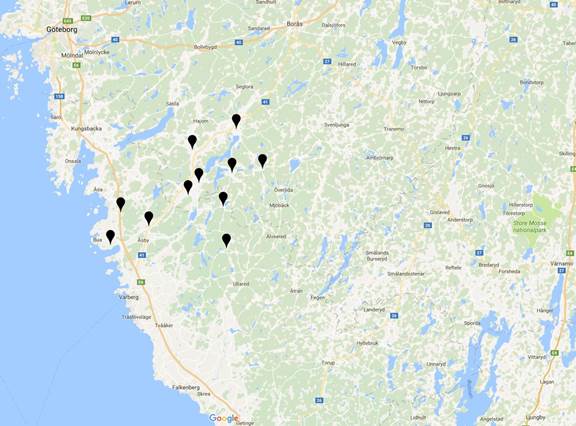
Map 5:
Strict division between free da and enclitic di in spontaneous speech (see (6h)).
Why is the distinction between da and di
not mentioned in the literature? I suspect that it has to do with the fact that
the distinction is quite new. For instance, as late as 1927, Lindberg,
describing the Öxnevalla dialect, notes both da and di, but in his examples, the di
is not restricted to post-verbal contexts (Öxn2:01, 04). The audio recordings,
where di is indeed a post-verbal clitic, are predominantly from the 1950s and 1960s. In
other words, these records were simply not accessible to dialectologists like Landtmanson, Kalén and Lindberg.
In present-day Viskadalian, the enclitic di occurs only marginally, and the free
morpheme da hardly at all. Today, the
standard-like dum
(cf. standard dom) is often used across the board.[15]
2.3.2. Second person in secondary
sources
The occurrence of second person reference in the audio recordings is, as
stressed before, only sporadic. More specifically, there is no single informant
on tape who uses all four types shown in (5b–b') and (5g–g'), although each
type is attested somewhere in the collection of spoken material. Turning
instead to the written records, and first taking 2sg into consideration, the largest collection of examples
representing the two types in (5b-b') comes from the Hallandian
parish of Fagered, just on the border with Westrogothia.
We have no reason to believe that Fagered
was special in any way. This parish happened to be targeted by one of the most
influential recorders of folklore of his time, namely Johan Kalén,
since this was the parish where he started his professional career (as a
teacher). In addition, Kalén was particularly keen on
documenting authentic dialogue, which naturally contains much second person
reference, especially in the singular. Nevertheless, it is probably significant
that the area where Fagered is situated is quite far
from the coast and very close to Westrogothia. In the
literature, inflection for 2sg
clearly emerges as more of a Westrogothian than a Hallandian trait. Landtmansson states (1950:135) that 2sg
inflection occurs both east and north of Mark (the hundred furthest to the
southwest). Even earlier, Hof (1993[1773]:42) noted that 2sg inflection was common among country
folk all over Westrogothia. Consequently, in the Viskadalian wedding poem from 1746, inflection for 2sg is thriving: du ska-tt waita,
‘you.sg shall.prs.sg-2sg know’ – däri sa-st-e sant, ‘therein say.pst-2sg=you.sg true’ (Öxn3:310, 311). By contrast,
in Halland, slightly further to the south, the
earliest descriptions of verbal paradigms that we have do not contain any inflection
for 2sg (see Colliander
1868:26–29, Bondesson 1880:III–IV).
As noted, the (s)t affix is restricted to
verbs without present tense r. But,
even with verbs where the affix is licit, the inflected form is more typical in
inverted contexts (du ska
– ska-t=ä, ‘you.sg shall.prs.sg’ – ‘shall.prs.sg-2sg=ä’). This has been observed for
northern Halland (Nilsson 1959:1150) and Westrogothia (Belfrage 1871:13)
alike. I discuss this tendency further in section 3.
Whereas the 2sg
affix is something of an eastern (or Westrogothian)
trait, the usage of the full 2pl
affix (including n) followed by
enclitic ä (see (5g, 6g)) is clearly
a western (or Hallandian) trait. The only examples of
the enclitic ä in 2pl that I have come across are from the
parishes surrounding the outlet of the river Viskan: vör-en=ä, ‘be.pst.pl-2pl=ä’ (Strå:224B); well-en=ä,
‘want-2pl=ä’ (Värö2:14); sko-n=ä, ‘shall.prs.pl-2pl=ä’ (Himl:72); förstå-n=ä, ‘understand-2pp=ä’
(Ås:4227B). The n of the affix is not
as robust further up the river: in the Öxnevalla
record from 1927 mentioned above, some verbs are reported as having the n (få-n, ‘get.prs-2pl’, vess-te-n, ‘know.pst-pst-2pl’(Öxn2:01)),
others as not having it (ät-e, ‘eat.prs-pl’, sto-e, ‘stand.pst-pl’ (ibid.)).
The only example with an inverted 2pl
pronoun in this particular collection lacks the n on the verb; the subject is thus the free pronoun I: Nu
skräpp-e I, ‘now boast-pl you.pl’ (ibid.; cf. (5gʹ, 6gʹ) above). Further down in Halland,
the inflection with n is much more
general, but in this area, there is no enclitic ä in any context: Wa vell-en
I?, ‘what
want-2pl you.pl’ (Faur:10).
3. Theoretical implications
Among the Viskadalian clitics
described in this article, one stands out: ä.
The other clitics, ik, en, na, et and di, are obviously clitic versions of the
full phi-bundle: they mean the same thing as their free counterparts, but they
are prosodically dependent on the verb, which, in
turn, restricts their syntactic distribution. By contrast, ä occurs whenever the referential meaning of the subject is
expressed in the preceding verbal ending (by (s)t, m,
or n). Below, I present an analysis
of the Viskadalian clitics
that relates both their restricted syntax and the versatile nature of ä to the spell-out of prosodic phrases.
In their 2003 paper, Ackema & Neeleman discuss prosodically conditioned morphological reduction in a wide
selection of languages (both in the past and the present). For instance, the
authors show that pronominal subjects are reduced to clitics
in Middle Dutch whenever they are in the same prosodic phrase (indicated by
{…}) as another head: {datt=en}, ‘that=he’ (Ackema & Neeleman 2003:705). As I show in 2.2.2, it is also true in Viskadalian that subject clitics
need to be in the same prosodic phrase as a head, but not just any head. Unlike
Middle Dutch clitics, Viskadalian
clitics demand a verbal host: ?*{att=ik}, ‘that=I;
{kan=ik}, ‘can.prs.sg=I’
(Ist2).
In other languages, for instance Old
French, pronominal subjects can be fully reduced (i.e. deleted) when they are
in the same prosodic phrase as an inflected verb containing the same
phi-features as the pronoun: {corur-ent Ø},
‘ran-3pl (they)’ (example from
Adams 1987). Ackema & Neeleman
(2003:723–725) analyse this as a reduction of feature redundancy within the
prosodic phrase. As I mention in 2.3.1, similar deletion is attested on the
edges of the Viskadalen area: {kör-d-om
Ø}, ‘drive-pst-1pl’ (we) (Dags:2912B).
Meanwhile, in other neighbouring varieties, the pronominal subject may be
intact but the affix is reduced: {fing-e vi}, ‘get.pst.pl-pl
we’ (Örb2:6208). Here the phi-features of the verb are only partially reduced:
the distinct 1PP ending (m) is
deleted, rendering a general plural (e).
This sort of partial reduction of an affix that carries the same features as
the pronoun is also widely attested in other languages: Ackema
& Neeleman give examples from Arabic and Dutch
(2003:690–705; see also Neuman, 1925:181–186, for
examples from Old Swedish).
What Ackema
& Neeleman claim as being unattested, however, is
the partial reduction of a pronoun (2003:730). From a theoretical viewpoint,
however, such a difference is unexpected. Why should the phonological component
(where reduction takes place) care, as it were, if the partially reduced bundle
is tied to a pronoun or to a verb? In fact, I believe that the Viskadalian ä
fills precisely this empirical lapse, being indeed an example of a partially
reduced pronominal phi-feature bundle. Recall, first, that inverted 2sg, 1pl
and 2pl pronouns are all spelled
out as ä when the phi-features of
these persons are present on the verb. Thus, it seems reasonable to conclude
that the ä at least carries less
referential information than any of the free pronouns. However, it cannot be
that all of its phi-features are reduced and that the ä is an expletive. Such an analysis predicts that ä should be suitable as a
non-referential subject, which is contrary to fact: *nu kan=ä regna, ‘now can.prs.sg=ä rain’. Instead, the ä could be a realization of exactly the
one phi-feature that 2sg, 1pl and 2pl have in common, that is, what is left of the pronominal
phi-feature bundle after the partial reduction of redundancy has taken place.
Clearly, this has to be some sort of participant feature, but I will not go
into any details here.
Still, I want to point out that any analysis of ä that treats it as an effect of
redundancy deletion is unable to capture its entire repertoire. Certainly, in
the plural this analysis works fine: the ä
is there only when there is an inflectional ending conveying the
referential meaning of the subject (m
or n). But in 2sg, the ä occurs
even without inflection, that is when the pronominal bundle appears to be
non-redundant ({få-r=ä}, ‘get-prs.sg=ä’ (Fag:95)). In order for
the reduction analysis to work here, we would need to assume that inflection is
underlyingly present in these contexts and that, for
some reason (possibly related to the r-ending),
the (s)t-affix
is suppressed, but only after it has triggered the reduction of du ä. A more straightforward (but not very
elegant) account could be to analyse the ä
as a clitic with 2sg
meaning in these particular contexts (i.e. there would be two separate äs).
Another complicating factor with regard to the
morpheme (s)t
is that it is more common in VS contexts (as I mentioned in 2.3.2 above). In
fact, in present-day Viskadalen, informants judge the
(s)t-ending as ungrammatical with SV
order, although they often use it with inverted word order: ?du kan-t,
‘you.sg can.prs.sg-2ps’, Wa blai-st=ä å?, ‘what become.pst-2sg=ä
of’ (Ist2). This strict limitation to VS order suggests that (s)t is not an
affix anymore; instead, it has been reanalysed as part of the enclitic pronoun ä. That such a reanalysis has indeed
taken place can be deduced from the sources quite early on, at least in the
parishes towards the coast. What we find there are examples such as töck-er=tä, ‘think-prs.sg=tä’
(Himl:73) and behöv-er=stä, ‘need-prs.sg=stä’ (Dags:2917B), along with uninflected verbs in SV
contexts (du ha-de, ‘you have-pst’ (Dags:ibid.)).
As we know, with present tense r, as
in these two cases, there was never any 2sg
inflection to begin with (cf. tôck-er=ä, ‘think-prs.sg=ä’ (Fag:107)).
However, if (s)t=ä is perceived as
one morpheme, that is as a 2sg clitic (i.e. (s)tä), it makes perfect sense that the limitations
associated with the affix (“do not attach to present tense r”) have no significance anymore.
However, the affix legacy is clearly visible in the
high degree of formal variation that the 2sg
clitic displays. Exactly how the inherited allomorphy from its affix days is accommodated in systems
without inflection for 2sg is not
clear to me. The only conclusion I dare to draw is that the reanalysed clitic contains elements of the original affix, but that
the distribution of these elements is not guided by the same principles as it
was when (s)t
was an affix. Apart from the stä and tä after the present tense r mentioned just above, we find, on the one hand, s-less forms where the affix originally
contained the s (ha=tä, ‘have=you.sg’ (Träsl); cf. ha-st have-2sg’ (Fag:135)), while on the other
hand, there are also s-forms where
the inflectional affix never contained any s
(kan=stä, ‘can.prs.sg=you.sg.’(Faur:54);
cf. kan-t ‘can.prs.sg-2sg’ (Fag:64)). In addition, the ä sometimes occurs with uninflected
verbs that were always inflected in the traditional system (e=ä, ‘be.prs=you.sg’ (Mark:3); cf. ä-st ‘be.prs-2sg’ (Fag:73)). In order to fully
understand this variation in clitic form, we need to
investigate more thoroughly the entire clitic system
of present-day Viskadalian.
4. Summary
In this article, I direct my attention to the subject pronouns of the
previously neglected Swedish dialect of Viskadalen (“Viskadalian”). The pronominal subjects of this variety (in
its traditional form) come in two guises: full pronouns, which are possible in
all contexts, and enclitic forms, which are prosodically
dependent on the finite verb. I show that some clitics
are more widespread than others. For instance, the 1sg clitic ik is restricted to a relatively
small geographical area around the lower reaches of the river Viskan, whereas the 3pl
clitic di,
although having acquired its clitic status quite
recently, occurs in a larger area. The Viskadalian clitics are semantically equivalent to the full pronouns in
all cases but one: the fascinating exception is ä. This clitic combines with all finite
verbs that are distinctively inflected for person and number. I argue that ä represents a reduced phi-feature bundle,
and that the reduction is triggered by the semantic richness of the verbal
affix.
Acknowledgements:
This research is funded by Knut and Alice Wallenberg Foundation (KAW,
grant 2011.0245) through The Swedish Academy. I would like to thank the two anonymous
reviewers for helpful comments. Thanks also to Thomas Magnusson, whose
morphological memories from his childhood summers in Värö
were the spark that ignited my interest in Viskadalian.
Quoted sources[16]
Dags = Dagsås (par), ISOF nr.: 2911B, 2912B, 2917B. [audio, recorded in 1962]
Fag = Fagered
(par), ISOF nr.: DAGF, 269F:II. [written; recorded in the
1890s]
Faur = Faurås
(hd), in: Bondeson, August 1880. Halländska sagor. Lund: Fr.
Berlings boktryckeri och stilgjuteri.
Grime = Grimeton (par), ISOF nr.: 1937B. [audio, recorded in 1957]
Grimm = Grimmared
(par), ISOF nr.:227, 226B. [audio, recorded in 1956]
Gsjö = Gunnarsjö (par),
ISOF nr.: 1036B, 1037. [audio; recorded in 1960]
Himl = Himle
(hd), in: Hallin, Waldemar 1948. Svenskt folkmål. Stockholm:
Folket i bild.
Ist1 = Istorp
(par), ISOF nr.:6212–6214. [audio; recorded in 1948]
Ist2 = Istorp (par),
awaiting ISOF accession nr. [audio; recorded in 2016]
KarlG = Karl
Gustav (par), ISOF nr.: IFGH, 1676. [written;
recorded in 1929]
Käll = Källsjö
(par), ISOF nr.: 350B. [audio, probably
recorded in the 1960s]
Mark = Mark
(hd), in Johansson, Gilbert 2003. Vi
kunnum vi mä I–II. Horred: Horreds hembygdsförening.
Strå = Stråvalla
(par), ISOF nr.: 224A–B. [audio; recorded in 1966]
Surt = Surteby (par), ISOF nr.: 7589B2. [audio; recorded in 1957]
Tores = Torestorp (par), ISOF
nr.: 255A_m24. [audio;
recorded in 1936]
Träsl = Träslöv (par), in: Läjesboa, parlör (xsl-file from the Facebook group Vi som tyckom de e roligt mä Läjesboa).
Vedd = Veddige
(par), ISOF nr.: 2064A. [audio; recorded in 1958]
Värö1= Värö (par), ISOF nr.:245A. [audio: recorded in 1967]
Värö2 = Värö (par), ISOF nr.:7827. [written; recorded in 1962]
Värö3 = Värö (par), ISOF nr.: 8362. [written; recorded in 1964]
Örb1 = Örby
(par), ISOF nr.: 6209. [audio; recorded in 1948]
Örb2 = Örby (par), ISOF nr.: 6207–6208. [audio;
recorded in 1958]
Öxa = Öxabäck (par), ISOF
nr.:5187. [audio; recorded in 1958]
Öxn1 = Öxnevalla (par), ISOF
nr.: 6804A2, 6804B, 6805A–B, 6806A1. [audio; recorded in 1956]
Öxn2 = Öxnevalla (par), ISOF
nr.:1604:01, 04. [written;
recorded in 1927]
Öxn3 = Öxnevalla
(par), in: Lundell, Johan August & Bengt
Hesselman, Bengt (eds.), 1937. Bröllopsdikter på dialekt och några andra
dialektdikter från 1600- och 1700-talen. Stockholm: Geber.
Ås = Ås (par), ISOF nr.: 4227B. [audio, recorded in
1967]
Audio sources (in addition to the quoted ones) ordered by colour on Map
2[17]
In dark grey: Harplinge (ISOF:1257A); Holm
(ISOF:56A–B); Skrea (ISOF:368A1);Torup
(ISOF:355–359); Alfshög (ISOF:387A); Kvibille (ISOF:2706A)
In black: Vessige (ISOF:378-383); Okome (ISOF:2262B1); Spannarp
(ISOF:2048–2056), Träslöv (ISOF:392–398); Stamnared (ISOF:2591–2592; 3439–3442).
In grey: Norra Hestra (ISOF:3296–3297); Bosebo
(ISOF:224–225); Långaryd (ISOF:683A2); Färgaryd (ISOF:2336–2349); Drängsered
(ISOF:349–354); Veinge (ISOF:2674–2685); Knäred (ISOF:3570–3573); Laholm
(ISOF:2668–2674); Ysby (ISOF:318–324); Hishult (ISOF:3593–3594); Hasslöv
(ISOF:2373–2380); Östra Karup
(ISOF:2692–2695); Våxtorp (ISOF:325–326); Ullared (ISOF:365B2, 374–376); Fagered/Gunnarp (ISOF:8114–8116); Älvsered
(ISOF:2601–2604); Mårdaklev (ISOF:748B); Kalv (ISOF:6798–6801; 747–748); Östra
Frölunda (ISOF:2599–2560); Håcksvik
(ISOF:4416–4419); Sexdrega (ISOF:1040); Ljushult (ISOF:1343); Roasjö
(ISOF:501–502); Fritsla (ISOF:2604–2609); Hajom (ISOF:251–253); Horred
(ISOF:6806–6809); Köinge (ISOF:376–378); Slättåkra (ISOF:2708–2716).
In white:
Idala; Frillesås; Förlanda; Ölmevalla; Gällinge; Förlanda; Kattunga; Sätila;
Hyssna; Kinna; Seglora; Holsljunga; Älekulla; Rolfstorp; Tvååker; Morup;
Ljungby; Gällared; Kinnared; Enslöv; Skummeslöv.
References
Ackema, Peter &
Ad Neeleman 2003. Context-sensitive Spell-out. Natural Language and Linguistic
Theory 21(4), 681–735.
Adams, Marianne
Patalino 1987. From Old French to the Theory of
Pro-drop. Natural Language and Linguistic Theory 5, 1–32.
Ahlgren, Perry 1978. Tilltalsordet ni: dess semantik och användning
i historiskt perspektiv. Diss., Uppsala University.
Belfrage, Åke Gustaf Leonard
1871. Om verbet i Vestgötamålet. Diss., Lund University.
Bondeson,
August 1880. Halländska sagor. Lund: Fr. Berlings boktryckeri och
stilgjuteri.
Colliander, C. A.
1868. Bidrag till kännedom om halländska allmogemålet. Diss., Lund University.
Dyvik,
Helge J. 1978. Breaking in Old Norse and Related Languages: A Reassessment of the
Phonetic Conditions. Arkiv för nordisk filologi 93, 1–37.
Grass, Eva, 1970. Växlingen di ~ dåmm i Eskilstuna stadsspråk.
Undersökning av ett recessivt språkdrag. (FUMS Rapport nr 16.) Uppsala:
Uppsala University.
Grill,
Erik 1954. Hallands städer. In:
Hallands historia 1, Från äldsta tid till freden i Brömsebro 1645.
Halmstad: Hallands läns landsting.
Götlind, Johan & Samuel Landtmanson
1940–1947. Västergötlands folkmål 1–3. Uppsala: Kungl. Gustav Adolfs
Akademien för svensk folklivsforskning.
Hallin,
Waldemar 1948. Svenskt folkmål. Stockholm: Folket i bild.
Hof, Sven 1993
[1773]. Den västgötska dialekten: till
någon belysning av det forna och nuvarande svenska språket genom en filologisk
avhandling och en förteckning över västgötska ord förklarad. Translated
from Latin by Sven Blomgren. Skara: Fören. för västgötalitteratur.
Horn af Åminne, Adam 2015. Viljen I
veta? Om verbens pluralböjning i sydvästsvenska dialekter. MA thesis, Dept. of Scandinavian languages, Uppsala
University.
Howe, Stephen 1996. The personal pronouns in the Germanic
languages: a study of personal pronoun morphology and change in the Germanic
languages from the first records to the present day. Berlin:
de Gruyter.
Indrebø, Gustav
2001. Norsk målsoga. Bergen: Norsk bokreidingslag.
Kalén, Johan
1923. Ordbok över Fageredsmålet. Göteborg: Elanders boktryckeri
aktiebolag.
Landtmanson, Samuel 1950. Västergötlands
folkmål 4. Formläran. Text och kartor. Uppsala: Kungl. Gustav Adolfs
Akademien för svensk folklivsforskning.
Landtmanson, Samuel 1952. Västgötamålet. Stockholm: Almqvist &
Wiksell.
Larsson,
Kent 1988. Den plurala verbböjningen i äldre
svenska: studier i en språklig förändringsprocess. Diss.,
Uppsala University.
Linge, Lars 1969. Gränshandeln i svensk politik under äldre Vasatid. Lund: Gleerups.
Lundell, Johan A.1909. Folkmålet. In: Nordisk familjebok, entry ”Halland”.
Stockholm: Nordisk familjeboks förlag.
Neuman, Erik 1925. Kritiska strövtåg i
svensk historisk formlära. Nysvenska studier 5, 165–213.
Nilsson,
Sture 1959. Folkmålen i Halland. I: Hallands historia. 2, Från freden i Brömsebro till våra dagar.
Halmstad: Hallands läns landsting.
Pamp,
Bengt 1978. Svenska dialekter.
Stockholm: Natur o. kultur.
Skautrup, Peter
1944. Det danske sprogs historie. Vol. 1, Fra guldhornene till jyske lov. Copenhagen:
Gyldendalske bogh.
Skott, Fredrik 2008. Folkets
minnen: traditionsinsamling i idé och praktik 1919–1964. Diss.,
Gothenburg University.
Spencer, Andrew &
Luis, Ana R. 2012. Clitics: an introduction. Cambridge: Cambridge University Press.
Tylden, Per
1944. Me-Vi: ein studie frå det gamalnorske og
mellomnorske brevriket.
Diss., Oslo University.
Wessén, Elias
1958. Svensk språkhistoria. 1,
Ljudlära och ordböjningslära. Stockholm: Almqvist & Wiksell.
Wigforss, Ernst 1913–1918. Södra
Hallands folkmål: ljudlära. Stockholm: Norstedts.
Zwicky, Arnold
M. 1985. Clitics and Particles. Language 61, 283–305
Noreen, Adolf
1904. Altnordische Grammatik 2,
Altschwedische Grammatik: mit Einschluss des Altgutnischen. Halle:
Niemeyer.
Reinhammar, Vidar 1975. Pronomenstudier.
Diss., Uppsala University.
SAG = Teleman, Ulf, Staffan Hellberg
& Erik Andersson 1999. Svenska
Akademiens Grammatik. Vol. 2. Ord.
Stockholm: Norstedts.
Contact
details:
Institute for Language and Folklore
The Department for Dialectology, Onomastics
and Folklore Research in Gothenburg
Vallgatan 22, SE-411 16 Gothenburg,
SWEDEN
E-mail: erik.petzell@isof.se